Financial results for the second quarter of 2026
Canada NewsWire
LÉVIS, QC, Aug. 12, 2026
Desjardins announces its results for the second quarter of 2026
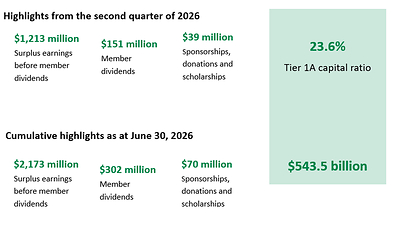
LÉVIS, QC, Aug. 12, 2026 /CNW/ -- With the results announced today, Desjardins Group has the means to realize its ambitions: giving its members and clients the support they need to be more financially empowered and making a real difference in the development of the communities it serves. For the second quarter of 2026, the provision for member dividends was increased by $151 million, compared to $113 million for the corresponding period of 2025, an increase of 33.6%. Amounts returned in the form of sponsorships, donations and scholarships totalled $39 million, of which $19 million came from the caisses' Community Development Fund.
Desjardins Group recorded surplus earnings before member dividends of $1,213 million, up $313 million, or 34.8% compared to the same period of 2025. Total net revenue rose by 13.0%, due in particular to higher net interest income in the Personal and Business Services segment. The Wealth Management and Life and Health Insurance segment also posted higher revenue, attributable to growth in assets under management and under administration, related in particular to the acquisition of Guardian Capital Group Limited (Guardian).(1) As for the Property and Casualty Insurance segment, higher revenue, essentially from automobile and property insurance, was partly offset by higher claims in the current year and the occurrence of flooding in Quebec.
________________________ | |
(1) | On March 23, 2026, through Desjardins Global Asset Management (DGAM), an indirect subsidiary of the Federation des caisses Desjardins du Québec (the Federation), Desjardins Group completed the acquisition of all the outstanding shares of Guardian Capital Group Limited (Guardian). |
"Our financial performance has value only if it translates into tangible benefits for our members and clients as well as for communities," said Denis Dubois, President and Chief Executive Officer of Desjardins Group. "This is the true strength of our cooperative model: the results we generate enable us to give back and take action where the needs are greatest, particularly in the area of affordable housing. To date, more than 7,000 housing units have been built, are under construction or have commitments in place as part of our ambition to support 10,000 units by 2028, in order to help tackle the affordability crisis. This same desire to make a tangible impact is reflected in our support for community development projects across the country, such as our $1 million contribution to the mining innovation zone in Rouyn-Noranda, as well as in the support we are providing to individuals and businesses in an economic climate that remains challenging. The discussions I've had over the past few months during our tour of communities have confirmed that people are looking for a strong financial partner that is committed and attuned to their realities. And that is exactly the role we intend to continue playing."
For the first six months ended June 30, 2026, Desjardins Group recorded surplus earnings before member dividends of $2,173 million, up $535 million from the same period in 2025. This growth was due in particular to the results of the Personal and Business Services segment, which benefited from higher net interest income and a decrease in the provision for credit losses. The Property and Casualty Insurance segment also contributed to this increase through higher revenue from automobile and property insurance. For the Wealth Management and Life and Health Insurance segment, the increase in revenue attributable to the growth in assets under management and under administration, notably following the acquisition of Guardian, was offset by an increase in expenses related to these items.
Strategic partnership in assistance services
During the quarter, Desjardins reached a significant milestone in the development of its insurance assistance offer when it announced a major 10-year strategic partnership with CanAssistance. The goal of this partnership, which will close in 2027 and which includes CanAssistance's acquisition of Desjardins's Assistel platform, is to strengthen the quality and continuity of the assistance services offered to Desjardins members and clients.
Support for women's sports and community engagement
Desjardins also announced multi-year partnerships with Halifax Tides and Montréal Roses, reaffirming its commitment to supporting the development of professional women's sport in Canada. Among other things, these initiatives seek to foster inclusion, promote inspirational models and generate positive, sustainable impacts in communities.
Leadership in the climate transition
Five years after announcing its climate ambition, Desjardins has issued a report demonstrating tangible progress, particularly in terms of a significant increase in renewable energy's share of its financing portfolio and major investments in the energy transition. These steps taken bear witness to Desjardins's commitment to supporting members and clients in the transition to a low-carbon economy, while acknowledging ongoing challenges.
Raising awareness of climate risks
In the second quarter, Desjardins Insurance also helped advance awareness of climate risks through a national survey that revealed that Canadians are increasingly aware of severe weather events. The results highlight a need for support in the form of practical advice, providing Desjardins an opportunity to become a key player in prevention and financial education.
Recognition of the financial strength of Desjardins Financial Security
AM Best has assigned strong credit ratings to Desjardins Financial Security (DFS), recognizing its financial strength. DFS has been assigned a financial strength rating of A (excellent) and a long-term issuer rating of a+ (excellent), with a stable outlook. The agency thus underlined the strength of DFS's business model and its ability to honour its commitments to its policyholders.
FINANCIAL HIGHLIGHTS
Comparison of the second quarter of 2026 to the second quarter of 2025:
- Surplus earnings before member dividends of $1,213 million, up $313 million, or 34.8%.
- Total net revenue of $4,623 million, up $532 million, or 13.0%:
- Net interest income of $2,299 million, up $275 million, or 13.6%, mainly due to an improved net interest margin and growth in outstanding residential mortgages and business loans.
- Insurance service result of $615 million, up $22 million, or 3.7%.
- Net insurance finance result of $289 million, down $23 million, mainly due to gains on disposals of buildings realized in 2025, partly offset by favourable developments in the markets.
- Other income of $1,420 million, up $258 million, or 22.2%, primarily due to growth in assets under management and under administration, particularly following the acquisition of Guardian.
- Provision for credit losses of $165 million, compared to $203 million for the corresponding period of 2025. This decrease was due in part to the lower provision related to credit-impaired loans in the business loan portfolio.
- Gross non-interest expense of $3,112 million, up $162 million, or 5.5%, due to the increase in spending on personnel, stemming in particular from the acquisition of Guardian, as well as higher commission fees and spending on technology.
- $190 million returned to members and the community,(1) up $43 million, or 29.3%.
Other highlights:
- Desjardins Group maintains strong capitalization levels, in accordance with Basel III requirements:
- Tier 1A capital ratio(2) of 23.6%, compared to 23.7% as at December 31, 2025.
- Total capital ratio(2) of 26.0%, stable when compared to December 31, 2025.
- Total assets grew 6.5% since December 31, 2025, to $543.5 billion as at June 30, 2026.
- Several securities issues were completed during the second quarter of 2026, including under the multi-currency medium-term note program and the legislative covered bonds program.
- In July 2026, Fitch, DBRS and Moody's each maintained the credit rating of the Federation.
Comparison of the first six months of 2026 with the first six months of 2025:
- Surplus earnings before member dividends of $2,173 million, up $535 million, or 32.7%.
- Total net revenue of $8,724 million, up $951 million, or 12.2%:
- Net interest income of $4,486 million, up $495 million, or 12.4%, mainly due to an improved net interest margin and growth in outstanding residential mortgages and business loans.
- Insurance service result of $990 million, up $107 million, or 12.1%, attributable to revenue growth in property and casualty insurance and the less unfavourable impact of the effect of the loss component on onerous contracts. However, this increase was partially offset by higher claims in the current fiscal year.
- Net insurance finance result of $448 million, down $38 million, or 7.8%, mainly due to gains on disposals of buildings realized in 2025, partially offset by favourable developments in the markets.
- Other income of $2,800 million, up $387 million, or 16.0%, essentially from management and custodial service fees related to the increase in assets under management and under administration, particularly following the acquisition of Guardian.
- Provision for credit losses of $377 million, compared to $413 million for the corresponding period of 2025. This decrease was due in particular to a decrease in the provision related to credit-impaired loans.
- Gross non-interest expense of $5,989 million, up $303 million, or 5.3%, due to the increase in spending on personnel, stemming in particular from the acquisition of Guardian, as well as higher commission fees and spending on technology.
- $372 million returned to members and the community,(1) up $86 million, or 30.1%.
_________________________________ | |
(1) | For more information on financial measures that are not based on GAAP, see "Non-GAAP financial measures and other financial measures" on page 4. |
(2) | In accordance with the Capital Adequacy Guideline for financial services cooperatives in particular, issued by the Autorité des marchés financiers (AMF). |
Non-GAAP financial measures and other financial measures
To measure its performance, Desjardins Group uses different Canadian generally accepted accounting principles (GAAP) (International Financial Reporting Standards (IFRS)) financial measures and various other financial measures, some of which are non-GAAP financial measures. Regulation 52-112 respecting Non-GAAP and Other Financial Measures Disclosure (Regulation 52-112) provides guidance to issuers disclosing specified financial measures, including the following measures used by Desjardins Group:
- A non-GAAP financial measure;
- Supplementary financial measures.
Non-GAAP financial measure
The non-GAAP financial measure used by Desjardins Group in this press release, and which does not have a standardized definition, is not directly comparable to similar measures used by other companies, and may not be directly comparable to any GAAP measure. It is defined as follows:
Return to members and the community
As a cooperative financial group contributing to the development of communities, Desjardins Group gives its members and clients the support they need to be financially empowered. The amount returned to members and the community, a non-GAAP financial measure, is used to present the overall amount returned to the community and is composed of member dividends, as well as sponsorships, donations and scholarships.
More detailed information about the amounts returned to members and the community may be found in the "Financial Highlights" table on the following page.
Supplementary financial measures
In accordance with Regulation 52-112, supplementary financial measures are used to show historical or expected future financial performance, financial position or cash flows. In addition, these measures are not disclosed in the financial statements. Desjardins Group uses certain supplementary financial measures, and their composition is presented in the Glossary on pages 46 to 51 of the MD&A for the second quarter of 2026.
FINANCIAL HIGHLIGHTS
As at or for the | As at or for the | |||||||||||
three-month periods ended | six-month periods ended | |||||||||||
(in millions of dollars and as a percentage) | June 30, | March 31, | June 30, | June 30, 2026(1) | June 30, | |||||||
Results | ||||||||||||
Net interest income | $ | 2,299 | $ | 2,187 | $ | 2,024 | $ | 4,486 | $ | 3,991 | ||
Net insurance service income | 904 | 534 | 905 | 1,438 | 1,369 | |||||||
Other income | 1,420 | 1,380 | 1,162 | 2,800 | 2,413 | |||||||
Total net revenue | 4,623 | 4,101 | 4,091 | 8,724 | 7,773 | |||||||
Provision for credit losses | 165 | 212 | 203 | 377 | 413 | |||||||
Net non-interest expense | 2,833 | 2,617 | 2,691 | 5,450 | 5,194 | |||||||
Surplus earnings before member dividends(3) | $ | 1,213 | $ | 960 | $ | 900 | $ | 2,173 | $ | 1,638 | ||
Contribution to surplus earnings by business segment(4) | ||||||||||||
Personal and Business Services | $ | 633 | $ | 607 | $ | 370 | $ | 1,240 | $ | 769 | ||
Wealth Management and Life and Health Insurance | 252 | 130 | 226 | 382 | 394 | |||||||
Property and Casualty Insurance | 303 | 154 | 307 | 457 | 341 | |||||||
Other | 25 | 69 | (3) | 94 | 134 | |||||||
$ | 1,213 | $ | 960 | $ | 900 | $ | 2,173 | $ | 1,638 | |||
Return to members and the community(5) | ||||||||||||
Member dividends | $ | 151 | $ | 151 | $ | 113 | $ | 302 | $ | 226 | ||
Sponsorships, donations and scholarships(6) | 39 | 31 | 34 | 70 | 60 | |||||||
$ | 190 | $ | 182 | $ | 147 | $ | 372 | $ | 286 | |||
Indicators | ||||||||||||
Return on equity(7) | 11.0 % | 9.1 % | 8.9 % | 10.1 % | 8.3 % | |||||||
Credit loss provisioning rate(7) | 0.19 | 0.27 | 0.28 | 0.23 | 0.28 | |||||||
Gross credit-impaired loans/gross loans(7) | 0.80 | 0.86 | 0.82 | 0.80 | 0.82 | |||||||
Efficiency ratio – Personal and Business Services(7) | 65.6 | 63.4 | 72.3 | 64.5 | 71.4 | |||||||
Insurance and annuity premiums – Wealth Management and Life and Health Insurance(7) | $ | 1,631 | $ | 1,631 | $ | 1,570 | $ | 3,262 | $ | 3,258 | ||
On-balance sheet contractual service margin (CSM) - Wealth Management and Life and Health Insurance(8) | 2,412 | 2,391 | 2,554 | 2,412 | 2,554 | |||||||
Direct premiums written – Property and Casualty Insurance(7) | 2,387 | 1,746 | 2,243 | 4,133 | 3,914 | |||||||
On-balance sheet and off-balance sheet | ||||||||||||
Assets | $ | 543,502 | $ | 524,320 | $ | 501,254 | $ | 543,502 | $ | 501,254 | ||
Loans, net of allowance for credit losses | 325,208 | 318,794 | 306,274 | 325,208 | 306,274 | |||||||
Deposits | 347,708 | 334,104 | 320,919 | 347,708 | 320,919 | |||||||
Equity | 44,352 | 42,933 | 40,315 | 44,352 | 40,315 | |||||||
Assets under administration(7) | 703,558 | 653,304 | 637,644 | 703,558 | 637,644 | |||||||
Assets under management(7) | 305,664 | 284,418 | 111,505 | 305,664 | 111,505 | |||||||
Capital and liquidity measures | ||||||||||||
Tier 1A capital ratio(9) | 23.6 % | 23.2 % | 22.9 % | 23.6 % | 22.9 % | |||||||
Tier 1 capital ratio(9) | 23.6 | 23.2 | 22.9 | 23.6 | 22.9 | |||||||
Total capital ratio(9) | 26.0 | 26.1 | 25.5 | 26.0 | 25.5 | |||||||
TLAC ratio(10) | 36.8 | 36.4 | 33.2 | 36.8 | 33.2 | |||||||
Leverage ratio(9) | 7.5 | 7.6 | 7.5 | 7.5 | 7.5 | |||||||
TLAC leverage ratio(10) | 11.6 | 11.7 | 10.6 | 11.6 | 10.6 | |||||||
Risk-weighted assets(9) | $ | 158,945 | $ | 156,869 | $ | 150,888 | $ | 158,945 | $ | 150,888 | ||
Liquidity coverage ratio(11) | 184 % | 176 % | 161 % | 184 % | 161 % | |||||||
Net stable funding ratio(11) | 133 | 130 | 131 | 133 | 131 | |||||||
Other information | ||||||||||||
Number of employees (full-time equivalent) | 53,470 | 52,788 | 52,517 | 53,470 | 52,517 | |||||||
(1) | The information presented as at June 30, 2026 and March 31, 2026 takes into account amendments to IFRS 9, "Financial Instruments", adopted on January 1, 2026. The comparative data have not been restated. For more information, see Note 2, "Accounting policies", to the Interim Combined Financial Statements. | |||||||||||
(2) | Some data have been restated to conform with the current period's presentation. | |||||||||||
(3) | The breakdown by line item is presented in the Statement of Income in the Interim Combined Financial Statements. | |||||||||||
(4) | The breakdown by line item is presented in Note 11, "Segmented information", to the Interim Combined Financial Statements. | |||||||||||
(5) | For more information on non-GAAP financial measures, see "Non-GAAP financial measures and other financial measures" on page 4. | |||||||||||
(6) | Including $19 million from the caisses' Community Development Fund ($15 million for the first quarter of 2026, $17 million for the second quarter of 2025, $34 million for the first six-month period of 2026 and $30 million for the first six-month period of 2025). | |||||||||||
(7) | For additional information on supplementary financial measures, see "Non-GAAP financial measures and other financial measures" on page 4. | |||||||||||
(8) | On-balance sheet CSM of $2,615 million ($2,599 million as at March 31, 2026 and $2,809 million as at June 30, 2025) presented net of reinsurance in the amount of $203 million ($208 million as at March 31, 2026 and $255 million as at June 30, 2025). Included in the line items "Insurance contract liabilities" and "Reinsurance contract assets (liabilities)" on the Combined Balance Sheets. For more information, see Note 7, "Insurance and reinsurance contracts," to the Interim Combined Financial Statements. | |||||||||||
(9) | In accordance with the Capital Adequacy Guideline for financial services cooperatives issued by the AMF. | |||||||||||
(10) | In accordance with the Total Loss Absorbing Capacity Guideline ("TLAC Guideline") issued by the AMF and based on risk-weighted assets and exposures for purposes of the leverage ratio at the level of the resolution group, which is deemed to be Desjardins Group, excluding Caisse Desjardins Ontario Credit Union Inc. | |||||||||||
(11) | In accordance with the Liquidity Adequacy Guideline issued by the AMF. | |||||||||||
ANALYSIS OF BUSINESS SEGMENT RESULTS
Personal and Business Services Segment
Results for the second quarter
For the second quarter of 2026, surplus earnings before member dividends were $633 million, up $263 million from the same period in 2025. This segment benefited from the increase in net interest income related to an improved net interest margin and growth in residential mortgages and business loans outstanding. In addition, the decrease in the provision for credit losses compared to the second quarter of 2025 was due to a decline in the provision related to credit-impaired loans in the business loan portfolio. Lastly, non-interest expense posted a moderate increase of 0.7%, reflecting the focus on expenditure management.
Wealth Management and Life and Health Insurance Segment
Results for the second quarter
For the second quarter of 2026, the segment posted $252 million in net surplus earnings, up $26 million compared to the same period of 2025, stemming from the increase in other income due to business growth, developments in the markets and the operations acquired from Guardian. This increase was partly offset by the increase in expenses related to these items and the less favourable experience in disability insurance.
Property and Casualty Insurance Segment
Results for the second quarter
For the second quarter of 2026, the segment posted $303 million in net surplus earnings, an amount comparable to that recorded in the second quarter of 2025. The growth in revenue from automobile and property insurance was offset by higher claims in the current year and the occurrence of flooding in Quebec.
Other Category
Results for the second quarter
For the second quarter of 2026, the Other category posted net surplus earnings of $25 million, compared to a net deficit of $3 million for the second quarter of 2025. The Other category includes mainly treasury activities and the intersegment balance eliminations required to prepare the Combined Financial Statements.
More detailed financial information can be found in Desjardins Group's interim Management's Discussion and Analysis (MD&A) for the second quarter of 2026, available on the Desjardins website or on the SEDAR+ website, at www.sedarplus.ca (under the Fédération des caisses Desjardins du Québec profile).
ABOUT DESJARDINS GROUP
Desjardins Group is the largest cooperative financial group in Canada and the eighth largest in the world, with assets of $543.5 billion as at June 30, 2026. Desjardins has been named one of the top employers in Canada by both Forbes magazine and Mediacorp. It offers a full range of products and services through its extensive distribution network, its online platforms, and its subsidiaries across Canada. In addition to being ranked among the world's strongest banks according to The Banker magazine, Desjardins has one of the highest capital ratios and one of the highest credit ratings in the industry.
CAUTION CONCERNING FORWARD-LOOKING STATEMENTS
Desjardins Group's public communications from time to time include oral or written forward-looking statements, within the meaning of applicable securities legislation, particularly in Quebec, Canada and the United States. Forward-looking statements are found in this press release and may also be incorporated in other filings with Canadian regulators or in any other communications. In addition, Desjardins Group's representatives may make oral forward-looking statements to investors, the media and other parties.
The forward-looking statements include, but are not limited to, comments on Desjardins Group's objectives regarding financial performance, priorities, vision, operations, targets and commitments, its strategies to achieve them, its results and its financial position, economic as well as financial market conditions, the outlook for the Quebec, Canadian, U.S. and global economies, and the regulatory environment in which we operate. Such forward-looking statements are typically identified by words or phrases such as "target," "objective," "timing," "outlook," "believe," "predict," "foresee," "expect," "intend," "have as a goal," "estimate," "plan," "forecast," "anticipate," "aim," "propose," "should" and "may," words and expressions of similar import, and future and conditional verbs, in all their grammatical variants.
By their very nature, such statements require us to make assumptions, and are subject to uncertainties and inherent risks, both general and specific. Desjardins Group cautions readers against placing undue reliance on forward-looking statements when making decisions since a number of factors, many of which are beyond Desjardins Group's control and the effects of which can be difficult to predict, could influence, individually or collectively, the accuracy of the assumptions, predictions, forecasts or other forward-looking statements, including this press release. Although Desjardins Group believes that the expectations expressed in these forward-looking statements are reasonable and founded on valid bases, it cannot guarantee that these expectations will materialize or prove to be accurate. It is also possible that these assumptions, predictions, forecasts or other forward-looking statements, as well as Desjardins Group's objectives and priorities, may not materialize or may prove to be inaccurate, and that actual future results, conditions, actions or events may differ materially from targets, expectations, estimates or intentions that have been explicitly or implicitly put forward. Readers who rely on these forward-looking statements must carefully consider these risk factors and other uncertainties and potential events, including the uncertainty inherent in forward-looking statements.
The significant risk factors that may affect the accuracy of the forward-looking statements in this press release include those discussed in the "Risk management" section of Desjardins Group's 2025 annual MD&A and of its MD&A for the second quarter of 2026 and include credit, market, liquidity, operational, insurance, strategic and reputation risk, environmental, social and governance risk, and regulatory risk.
Such factors also include those related to security (including cybersecurity) breaches, the uncertainty surrounding evolving cybersecurity threats given rapid developments in technological capabilities, fraud risk, fluctuations in the real estate market and household and corporate indebtedness, regulatory developments, including changes to liquidity and capital adequacy guidelines, and requirements relating to their presentation and interpretation, as well as interest rate and exchange rate fluctuations, inflation, climate change, geopolitical uncertainty, including the conflict in the Middle East and its impacts, in particular, on oil and gas prices, technological innovation, including the use of artificial intelligence, and data risk. Furthermore, there are factors related to the trade tensions with the United States and the impact that tariffs on certain Canadian exports as well as any resulting retaliatory tariffs could notably have on goods and services, businesses in certain industries, and the Canadian economy. Also of note are factors related to general economic and business conditions in regions in which Desjardins Group operates, including the risk of recession; as well as factors related to the critical accounting estimates and accounting standards applied by Desjardins Group; increased competition; geographic concentration; changes in the credit ratings assigned to Desjardins Group; reliance on third parties, including third parties' failure to fulfill their obligations to Desjardins Group; the ability to recruit and retain talent; and tax risk. Other factors include changes in consumer spending and saving habits, the potential impact of international conflicts on operations, public health crises, such as pandemics and epidemics, or any other similar events affecting the local, national or global economy, as well as Desjardins Group's ability to anticipate and properly manage the risks associated with these factors despite a disciplined risk management environment. Additional information about these factors is found in the "Risk management" section of Desjardins Group's 2025 annual MD&A and of its MD&A for the second quarter of 2026.
It is important to note that the above list of factors that could influence future results is not exhaustive. Other factors could have an effect on Desjardins Group's results. Additional information about these and other factors is found in the "Risk management" section of Desjardins Group's 2025 annual MD&A and of its MD&A for the second quarter of 2026.
The significant economic assumptions underlying the forward-looking statements in this press release are described in the "Economic environment and outlook" section of Desjardins Group's 2025 MD&A and of its MD&A for the second quarter of 2026 and can be updated in the interim MD&As subsequently filed. To determine economic growth forecasts in general, and for the financial services sector in particular, Desjardins Group mainly uses historical economic data provided by recognized and reliable organizations, empirical and theoretical relationships between economic and financial variables, expert judgments, and observed upside and downside risks for domestic and global economies.
Any forward-looking statements contained in this press release represent the views of management only as at the date hereof, and are presented for the purpose of assisting readers in understanding and interpreting Desjardins Group's financial position as at the dates indicated or its results for the periods then ended, as well as its strategic priorities and objectives as considered as at the date hereof. These forward-looking statements may not be appropriate for other purposes. Desjardins Group does not undertake to update any oral or written forward-looking statements that could be made from time to time by or on behalf of Desjardins Group, except as required under applicable securities legislation.
BASIS OF PRESENTATION OF FINANCIAL INFORMATION
This press release was prepared in accordance with the regulations in force of the Canadian Securities Administrators on continuous disclosure obligations. Unless otherwise indicated, all amounts are presented in Canadian dollars and are primarily from Desjardins Group's annual and interim combined financial statements, which were prepared in accordance with IFRS as issued by the International Accounting Standards Board (IASB) and the accounting requirements of the AMF, which do not differ from IFRS. IFRS represents Canadian GAAP. On January 1, 2026, Desjardins Group adopted amendments to IFRS 7, "Financial Instruments: Disclosures," and IFRS 9, "Financial Instruments." Comparative data have not been restated. For more information, see Note 2, "Accounting policies," to the Interim Combined Financial Statements.
SOURCE Desjardins Group

